
Developing a set of Web Design Blog Ideas for Local Businesses may seem, at first glance, like a relatively simple editorial exercise. Yet the moment one attempts to frame its boundaries, a certain conceptual friction begins to surface. What looks straightforward from afar often grows unexpectedly intricate once the uneven realities of local enterprises come into focus. The task shifts from curating a list of topics to examining how community-rooted businesses negotiate their online presence, particularly as they attempt to balance visibility, usability, and credibility. Learn more about it by visiting our primary page.
Some observers argue that in competitive digital environments, local enterprises survive by maintaining coherent, trustworthy websites. The claim has persuasive elements, although it risks overlooking the complex situations non-specialists regularly face. A thoughtfully written blog can evolve, gradually and almost imperceptibly, into a reflective space where observations about emerging aesthetics, shifting technologies, and subtle branding adaptations intersect in productive ways. The following discussion outlines several thematic directions that Web Design Blog Ideas for Local Businesses might explore. These themes do not aspire to definitive conclusions. Instead, they offer provisional conceptual frameworks that may help businesses think through their digital decisions with slightly more nuance.
Why Local Businesses Might Benefit from a Web Design Blog
The assumption that web design blogs belong exclusively to agencies or technically trained professionals has grown increasingly unstable. Potential customers often encounter a business online long before they interact with its products or services. Even owners who do not consciously engage with design theory must eventually make decisions about layout, color systems, readability, and broader accessibility. It is precisely in this overlooked design labor that a blog can intervene .For readers interested in deeper examinations of user-focused design, the Nielsen Norman Group offers thoughtful analyses that complement this discussion.
A blog allows a business to articulate something like an evolving digital logic. Topics involving online marketing website design or the complexities of website content development services can be reframed through the lens of local practice. When anchored in community concerns, these discussions begin to resonate differently. They help establish a vocabulary through which design can be interpreted rather than passively consumed.
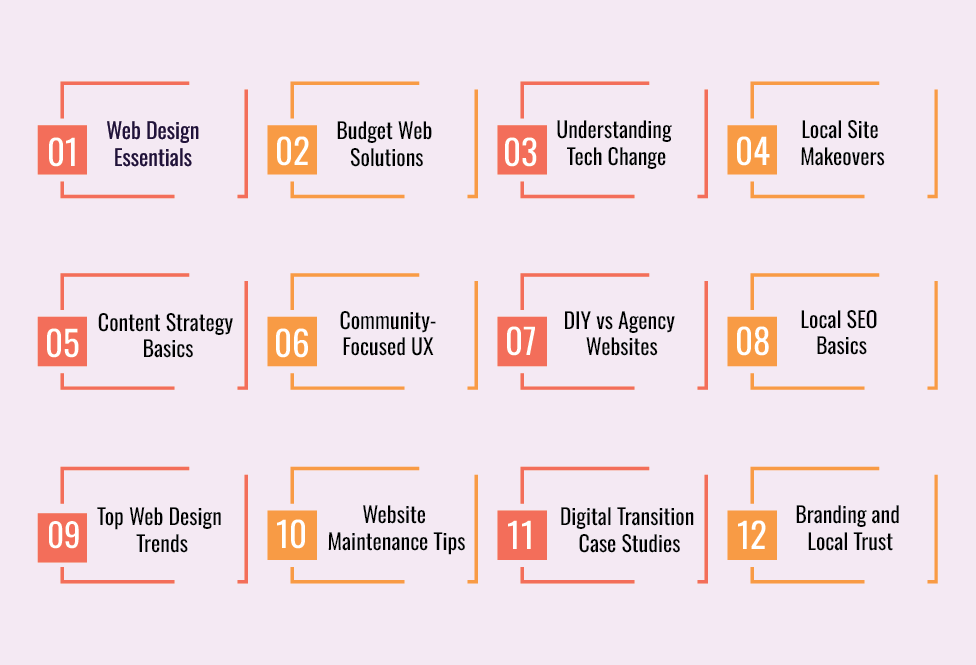
1. Introducing Foundational Web Design Concepts to Non-Specialists
One recurring topic involves explaining what makes a website function effectively. Many readers browsing Web Design Blog Ideas for Local Businesses have little familiarity with responsive scaling, typographic hierarchy, hosting conditions, or the small choices that shape user experience. A nuanced post might examine the gradual shift toward quieter, more spatially generous interfaces or reflect on how mobile-first habits have recalibrated what counts as intuitive design. Such reflections may naturally transition into exploring best designed websites 2025 predictions. Instead of asserting trends as foregone conclusions, the post could suggest that current tendencies appear to favor muted palettes or fluid navigational structures. Whether these tendencies persist is uncertain, yet considering them situates the local business within wider design conversations.
2. Helping Small Businesses Navigate Affordable Web Development
Affordability emerges repeatedly in discussions of Web Design Blog Ideas for Local Businesses. The common framing of templates versus custom builds may appear deceptively straightforward. In practice the decision is far more layered. Templates can offer efficiency, although they frequently introduce long-term limitations. Custom development may require a higher initial investment, yet it often provides structural adaptability that proves valuable over time. Short case reflections can clarify these subtleties. A florist might require only a single-page site anchored by visual hierarchy. A community clinic, however, may need a more elaborate architecture, including secure forms and appointment systems. In such cases affordability becomes less about minimizing cost and more about matching function to anticipated need.
3. Interpreting Ongoing Technological Changes
Technology evolves continuously, and web design decisions shift accordingly. Business owners often encounter algorithm updates or emergent standards without fully understanding their implications. A sudden change in search behavior, for example, can alter site visibility even when the business itself has altered nothing. A blog can examine how these developments affect smaller, locally oriented sites that may operate with limited maintenance budgets. The discussion might also consider automated testing tools or AI-assisted layout suggestions. Rather than embracing such tools uncritically, the blog could argue that their usefulness depends heavily on human interpretation. This view challenges the assumption that software alone can compensate for the absence of design insight.
4. Using Local Website Makeovers as Learning Material
Local businesses often learn by observing one another. Web Design Blog Ideas for Local Businesses could highlight redesigns within the community, noting not only the aesthetic outcomes but also the reasoning that led to those decisions. One post might contrast the demands of corporate website design with the needs of a neighborhood retailer. Another could explore how user pathways change after a simplified navigational system is introduced. These discussions may include gentle critique. Overcrowded menus, inconsistent spacing, or generic stock imagery can erode user trust. Acknowledging such issues positions the blog as analytical rather than purely promotional.
5. Exploring the Structure and Implications of Content Strategy
Content strategy frequently receives less attention than visual design, even though both shape how users move through a site. Posts about website content development services can consider how tone, clarity, and information hierarchy influence engagement. Since assumptions about user behavior underlie every content choice, the writing might adopt a slightly tentative tone. A post could ask whether extended storytelling truly enhances retention or whether it risks becoming an indulgence. Another might compare the precision of well-crafted microcopy to the reassurance offered by longer explanations. These discussions encourage readers to see content as a structural component rather than decorative add-on.
6. Addressing User Experience as a Community-Specific Practice
User experience is often treated as if it were universal. A blog oriented toward local businesses may question this assumption by examining regional device preferences, bandwidth limitations, or accessibility needs. Concerns about bilingual navigation or local communication norms reveal how design intersects with everyday practice. Such reflections help explain why web development for small business environments cannot simply replicate strategies used by larger corporations. What functions effectively in high-speed urban contexts may feel cumbersome or opaque in smaller communities.
7. Weighing DIY Website Builders Against Agency Support
Debates regarding DIY builders and full service web agencies tend to become polarized. A more balanced discussion would acknowledge the immediate convenience of builders while recognizing their long-term limitations. Agencies, although more expensive, can provide strategic coherence and tailored solutions. A blog that identifies situations where each approach is appropriate positions itself as a measured advisor. A very young startup may thrive with a simple builder, while a business anticipating future corporate website development might benefit from agency guidance.
8. Understanding Local SEO as Part of Design Logic
SEO is often framed purely as a marketing issue, yet design decisions contribute directly to search performance. Posts might examine how site speed, structural hierarchy, or schema markup influence visibility. Such analysis can distinguish between techniques relevant to national brands and those more suitable for smaller enterprises. Another post may consider why online marketing website design increasingly integrates SEO considerations into initial planning rather than as an afterthought.
9. Reflecting on Best Designed Websites 2025 Trends
Trend-oriented posts usually attract interest, though they require careful framing. A reflective overview might consider whether increasingly experimental visuals truly enhance usability or whether they risk obscuring essential information. A slightly skeptical tone can help readers understand that trends require contextual judgment rather than automatic adoption.
10. Providing Maintenance Practices and Checklists
Maintenance often receives insufficient attention. A blog could offer checklists explaining how broken links, outdated plugins, or abandoned scripts gradually undermine performance. Linking routine maintenance to visible outcomes helps readers understand why upkeep cannot be deferred indefinitely.
11. Presenting Case Studies of Digital Transition
Case studies allow abstract principles to appear in concrete form. A blog might follow a café integrating online ordering or a nonprofit reorganizing its navigation to improve donor engagement. These accounts do not serve as universal templates. They function instead as glimpses into how design choices influence daily operations.
12. Examining the Relationship Between Branding and Local Trust
Branding exerts influence quietly. A post could analyze how spacing, typography, or color choices shape perceptions of reliability. Comparing global branding norms to local expectations may reveal that what seems sleek in one context appears distant or impersonal in another. A modest critique of overly corporate styling may prompt small businesses to prioritize authenticity.
Conclusion
Developing Web Design Blog Ideas for Local Businesses involves more than compiling a list. It requires attentiveness to context, a willingness to engage with uncertainty, and an openness to revising assumptions about digital practice. A carefully written blog can help readers navigate shifting technologies, evolving aesthetics, and the layered dynamics of content strategy without presuming authority. By situating itself within ongoing conversations about website development and corporate website design, such a blog can demonstrate how navigation, branding, and structural decisions shape user trust. Over time such a blog may become a companion of sorts for businesses negotiating digital growth. Its significance lies not merely in visual guidance but in its capacity to help enterprises articulate, refine, and occasionally rethink their online identities. If you’d like to talk through your project or simply ask a question, you can reach us here.
Frequently Asked Questions
1. Why should a local business bother reading a web design blog?
Some owners stumble into web design without meaning to. A small change in a homepage photo, a misplaced button, a color that looks slightly off. These things begin quietly, then gather weight. Reading a web design blog may not solve everything, but it gives business owners a way to understand why certain digital decisions matter. It appears, at least from many examples, that design is less about visual decoration and more about shaping trust, movement, and clarity. The blog becomes a kind of companion. Not authoritative in the hard sense, but helpful enough that a shopkeeper or clinic manager might see the structure behind the choices they make. And once one sees that structure, even briefly, the rest feels less chaotic.
2. Are the concepts discussed here suitable for non-technical readers?
Generally, yes. The posts try to speak to people who have not spent years studying typography or interface theory. The language shifts a little between technical and conversational, but this is intentional. It mirrors the experience of someone who is learning, pausing, questioning, and returning. Readers may find that complex ideas soften when they appear in stories or examples. A note here, a hesitation there. The aim is not mastery but slow understanding, the sort that settles in after reading something that felt surprisingly clear for once.
3. How are these blog ideas different from typical web design trend lists?
Trend lists usually work like forecasts. Clean, confident, almost postcard-like in their certainty. This blog takes a more tentative path. It looks at trends and asks where they came from, who benefits from them, and whether they actually help small businesses. Sometimes the answer is yes. Other times the trend feels too glossy, too detached from local realities. The posts lean toward interpretation rather than prediction, almost as if they are trying to join a conversation already in progress. And in doing so, they resist the idea that design choices must follow whatever is fashionable this season.
4. I run a small business with a limited budget. Will these posts help me?
In many cases, they will. Small businesses often navigate tight budgets, unpredictable schedules, and shifting priorities. The blog tries to acknowledge that reality. Some posts explore inexpensive approaches, while others consider when spending a little more might prevent future frustration. This is not a simple calculation. It resembles a series of judgments that unfold over time. A business owner might discover that a template is enough for now, or that a modest custom adjustment solves a recurring issue. The posts try to illuminate these possibilities without insisting that one path is inherently superior.
5. Does the blog discuss corporate-level website design?
Yes, though not as a primary focus. Corporate sites sometimes appear as contrasts rather than models to follow. Their scale, structure, and tone often differ from what a small local business needs. By examining these differences, the blog invites readers to notice the pressures that shape corporate design, pressures that may not apply to a neighborhood bakery or local clinic. The comparison is used carefully. It is less a directive and more a reminder that digital forms arise from specific contexts, and that choosing a design style is also, in its own way, an act of understanding one’s place within a wider ecosystem.