
It might seem strange at first glance how a few words, almost whispered at the edge of a screen, can nudge a person toward a decision. Yet marketing history suggests this is very much the case. The psychology behind responsiveness, persuasion, hesitation, and the tiny spark that pushes a visitor to click is endlessly debated. As I began reviewing 50 Powerful Call to Action Phrases, I realized that these tiny utterances behave like small hinges moving very large doors. They appear simple, but they are rarely neutral. They carry intent. They invite movement. And, perhaps surprisingly, they reveal how language shapes decision-making in a digital world increasingly saturated with competing voices. Find all the details here.
So we start there, tentatively, with the awareness that a call to action is not merely a marketing trick. It is a linguistic signal that may open a path. Whether it is the gentle assertion of call us today or the more energetic appeal of get yours today, the effect arises from a complex interplay of clarity, timing, visual cues, and the reader’s own internal narrative. The debate around what counts as effective CTA wording appears ongoing, especially as digital marketing phrases shift and as audiences become more skeptical, cautious, or simply distracted. But one thing is widely accepted: the phrases that work best tend to feel alive. Urgent, but not desperate. Clear, without being crude.
Context Shapes Every CTA
Before we move deeper, there is a small observation many overlook. CTAs behave differently depending on context. What works on a restaurant menu page is rarely what works in persuasive writing or in academic essays. In fact, when students ask, what is a call to action in an essay?, the answer often sits somewhere between concluding insight and gentle argumentative push. It is not the same as a sales pitch. It is more reflective. Less commercial. And yet the underlying mechanics remain similar: a prompt toward intellectual or practical next steps. Digital marketers argue endlessly about synonyms. Is there another word for call to action that captures the same urgency? Some prefer invitation, others prompt, still others lean on appeal. The call to action thesaurus rarely settles anything. But the search for nuance seems to indicate a growing cultural awareness that language used for persuasion should evolve with sensitivity, not force.
CTAs as Flexible Tools
For many businesses and creators, stronger, more actionable wording is needed. And that is where the 50 Powerful Call to Action Phrases become useful, especially when adapted to the tone of the brand. Many popular websites, including HubSpot and Mailchimp offer generous libraries of CTA inspiration that marketers revisit repeatedly. They serve as reliable external sources when brainstorming begins to feel stale. The phrases below are not mechanical magic. They are possibilities. Each one may work, or may fail, depending on audience, intention, mood, and timing. Consider them as tools, rather than prescriptions.
50 Powerful Call to Action Phrases
(a shifting, interpretive list rather than a rigid formula)
- Get yours today
- Call us today
- Start your journey
- Limited spots available
- Claim your offer
- Redeem quote
- Join the waitlist
- Try it risk free
- Unlock your access
- Download instantly
- Reserve your seat
- Explore our menu (useful for call to action examples for restaurants)
- Make your appointment
- Request more info
- Begin now
- Learn more
- Continue reading
- Dive in
- Get started
- Add to cart
- Secure your discount
- Claim your bonus
- Upgrade now
- Subscribe for updates
- Try the demo
- See how it works
- Take the next step
- Don’t miss out
- Shop the collection
- Experience it today
- Get instant access
- Start saving
- Send us a message
- Sign up free
- Continue to checkout
- Explore your options
- Request a callback
- Book your session
- Share your feedback
- Tell us what you think
- Continue exploring
- Follow the journey
- Get the full guide
- Begin your free trial
- Discover more
- Compare plans
- Proceed
- Contact support
- Start your application
- Move forward
The list, although neatly arranged, is not meant to be consumed as rigid instruction. Most phrases may be adapted or softened. Some may be too aggressive depending on the environment. The idea is to offer a palette.
Why these words work at all
A question surfaces repeatedly: why do these tiny lead in phrases matter so much? In practice, they seem to operate as signposts for attention. Human cognitive processing favors clarity. Ambivalent buttons or vague closing statements leave people drifting. Precision anchors them. Yet the effectiveness of clarity cannot be separated from visual cues. Many designers stress the importance of call to action images or a clean call to action image that subtly guides the eye. Sometimes even call to action pictures become the difference between a click and a scroll-away. In persuasive writing, especially in essays, a CTA works differently. When students ask, what is a good call to action for an essay?, educators often encourage something reflective: perhaps urging readers to reconsider an assumption, to explore further research, or to imagine alternative outcomes. It is not a sales technique. It is an intellectual invitation.
CTA language as a cultural reflection
Interestingly, CTAs reveal cultural preoccupations. They expose what we assume motivates people: urgency, reward, access, belonging. When marketers discuss call and messaging ads terms, they often debate how direct those terms should be. Some believe in brevity. Others argue for more elaborate digital marketing phrasing. The tension remains unresolved.
A further complication arises from the increasing sophistication of content strategy tools. Some businesses rely on automated call to action generator systems, which may be helpful, but often create text that feels slightly sterile. Human nuance tends to go missing. Marketers occasionally critique these tools for producing language that lacks emotional texture, which is why many still prefer manual brainstorming supported by high-quality resources like those available through HubSpot.
When CTAs fail
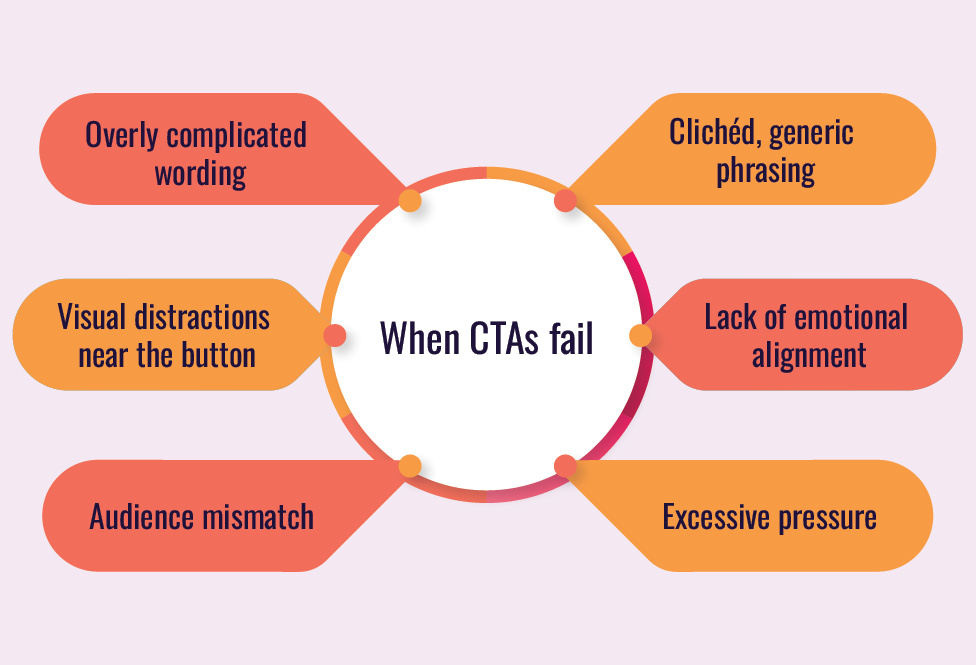
Failure is often more revealing than success. Common reasons include:
• Overly complicated wording
• Clichéd, generic phrasing
• Visual distractions near the button
• Lack of emotional alignment
• Audience mismatch
• Excessive pressure
The most overlooked failure, though, may be tone. People sense when language does not align with intent. A CTA that feels hollow or manipulative rarely performs well.
Images, phrasing, and small linguistic shifts
As researchers of digital rhetoric suggest, the relationship between images and text becomes crucial for CTAs. A carefully positioned picture can subtly direct attention. At the same time, the wording, even when short, may require experimentation. Tiny shifts from submit to send or from order to get yours today can alter mood significantly. There is also the ongoing debate around call for action synonym variations. Some writers prefer urge, others prompt, a few even choose appeal. Each carries different emotional temperatures. A synonym call to action does not always produce identical results, so testing remains essential.
The Impact of CTAs
As we circle back to the underlying theme, it becomes clearer that the mechanics of persuasive language remain stubbornly nuanced. The list of 50 Powerful Call to Action Phrases offers a foundation, yet their value lies not in memorization but interpretation. A genuinely effective CTA is rarely the loudest phrase on the page. It is often the one that feels right, situated, and almost inevitable within the reader’s journey. If one examines call to action examples in persuasive writing or in commercial design, a pattern emerges. The most compelling CTAs are not manipulations. They are conversations. They acknowledge hesitation. They meet the reader where they already stand. And, perhaps more importantly, they suggest an action without demanding it. Marketers, creators, and writers might revisit 50 Powerful Call to Action Phrases whenever inspiration falters, yet the best CTAs will always be shaped by context, culture, and character. That is why resources such as HubSpot or Mailchimp remain in constant rotation for professionals needing updated insights. They remind us that persuasion is not a static science.
Conclusion
In conclusion, the evolving nature of language ensures that 50 Powerful Call to Action Phrases will never be a fixed, immutable list. It is a set of possibilities. It may help spark direction, yes, but it also invites experimentation. And in that experimentation lies the true craft of guiding readers toward meaningful action. See what we’re all about or connect with us here.